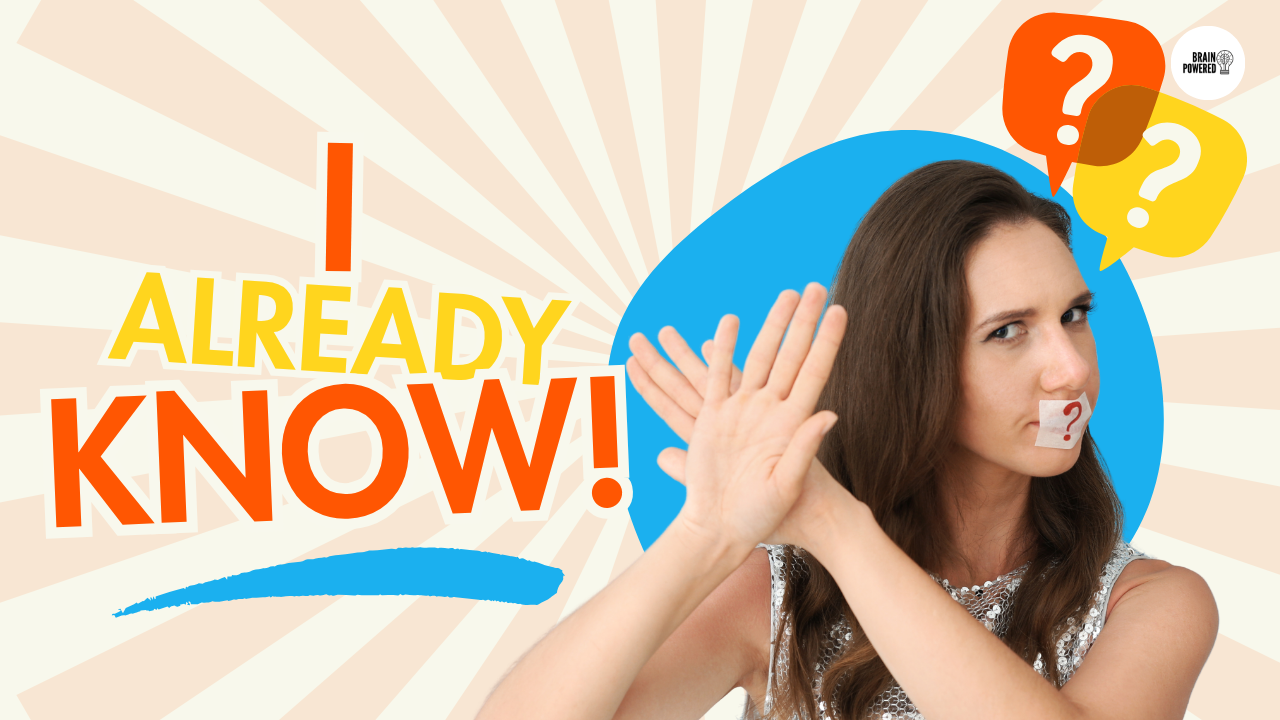
I didn't get to where I am by guessing. Years of pattern recognition, seeing enough similar situations to spot the shape of a new one faster than someone doing it for the first time - that's a genuine asset, and most of what looks like good instinct in senior leaders is really just well-earned pattern matching built from thousands of small decisions before this one.
Until a few weeks ago, when I was about to make a call I'd made a dozen times before and realised I hadn't looked at what was actually in front of me. I'd looked at my memory of it, and they weren't the same thing.
The problem was never that experience is useless. The problem is what it quietly does to the feeling of certainty, and how little that feeling has to do with whether you're actually right.
Certainty is a feeling, not a fact 🧠
Neurologist Robert Burton's central idea has stayed with me since I first read it: the feeling of knowing is generated by the brain, and it's a completely separate process from actually being correct. You can feel completely certain and be wrong, and you can feel uncertain and be right, because the feeling tracks familiarity rather than truth.
That's uncomfortable, because "I already know" doesn't feel like a bias in the moment - it feels like clarity, like the reward for having done this before, and that's exactly what makes it so hard to catch.
This isn't an argument against confidence. Confidence built over years of genuine skill and hard-won judgement is one of the most valuable things a leader can bring into a room. The trap is mistaking it for something else entirely: the automatic, unchecked feeling of already knowing. Real confidence can hold a question. Certainty tends to skip it.
Why my brain rewards being right⚡
Once I've formed a view, my brain doesn't neutrally look for evidence either way - it looks for evidence that confirms what I already believe. Confirmation bias isn't a character flaw; it's just how brains conserve effort, and if I'm honest, finding confirming evidence feels good because being right releases the same reward signal as any other win.
The more senior I've become, the more that loop gets reinforced. People are less likely to challenge us directly when we are senior, so confirming evidence often just walks in the door on its own - and nobody builds that dynamic on purpose. It's simply what happens when disagreement carries a social cost.
The room around you will quietly finish what your brain started 🪞
Here's the part that took me longer to see.
In my corporate role, thought I was "just Caroline" - fun, positive, hard-working - and that was my genuine internal picture of how I showed up. What I didn't know, until someone told me, was that junior members of my team were scared of me, not because of anything dramatic, but simply because the gap between my title and theirs meant my confidence didn't leave much room for theirs.
I didn't feel like the big boss - I felt like myself - and both of those things were true at the same time, producing completely different realities in the same room.
The cost wasn't immediately obvious, because nobody was rude and nobody pushed back in a way I had to manage. What I lost was quieter than that: ideas that never made it into the room, and people who had a better read on something but stayed silent because speaking up felt too risky.
This is what an echo chamber actually looks like in practice - not hostile or dramatic, but a room where people have quietly learned that challenging you carries a cost, and so they don't. Your confirmation bias operates internally, the environment reinforces it externally, and neither feels like a problem from the inside.
The bigger the experience, the bigger the blind spot 🔍
There's a predictive model of the brain worth understanding: we don't experience the world directly; we experience our brain's best guess about it, built from experience and updated only when the mismatch is big enough to notice. The more confident that guess, the bigger the mismatch has to be before the brain bothers updating it.
This should worry senior leaders more than it usually does. The more experienced I am, the more evidence it takes for me to notice I'm wrong, precisely because my model of the world feels so thoroughly tested. Seniority doesn't just earn trust in the pattern - it raises the bar for spotting when the pattern no longer applies. And if the environment around you has stopped producing challenge, that bar goes up further still.
Do the people around you actually feel safe to challenge you? 🔒
This is the question I've found hardest to answer honestly, because the answer isn't about your intentions - it's about their experience.
Saying "it's safe to speak up" is not the same as creating safety. I had to actively reward challenge when it came - name it, thank it, act on it visibly - and do that consistently enough that people started to believe it wasn't a trap. That took time, and it required me to sit with the discomfort of being challenged in a room where I was used to being the most experienced person present, and respond in a way that made it worth doing again.
Psychological safety isn't a culture value you put in a slide deck - it's the pattern of responses you build, one conversation at a time, until people trust that the cost of speaking up is lower than the cost of staying quiet. When I got that right, the quality of thinking in the room changed, not because the people changed, but because I finally had access to what they actually thought.
The question I've started asking instead ✅
Before I commit to a decision that feels obvious, I run through four questions rather than trusting the feeling of certainty on its own:
The last one is the newest addition, and it's the outward-facing version of the same discipline - not "am I biased?" but "have I built the conditions for the bias to be caught?"
So, what do I actually know?💡
Less than it feels like, most days, and I've made peace with that being useful information rather than a weakness. The leaders I trust most aren't the least confident ones - they're the ones who've learned to tell the difference between earned confidence and unchecked certainty, and who've built rooms where other people will speak up.
"I already know" isn't the end of thinking. It's usually the moment thinking was needed most, and quietly declined.
References 📚
- Nickerson, R. S. (1998). Confirmation Bias: A Ubiquitous Phenomenon in Many Guises. Review of General Psychology, 2(2), 175-220.
- Moore, D. A., & Healy, P. J. (2008). The Trouble with Overconfidence. Psychological Review, 115(2), 502-517.
- Burton, R. A. (2008). On Being Certain: Believing You Are Right Even When You're Not. St. Martin's Press.
- Clark, A. (2016). Surfing Uncertainty: Prediction, Action, and the Embodied Mind. Oxford University Press.
- Edmondson, A. (1999). Psychological Safety and Learning Behaviour in Work Teams. Administrative Science Quarterly, 44(2), 350-383.
|