|
Over the years, I’ve noticed something fascinating in my work.
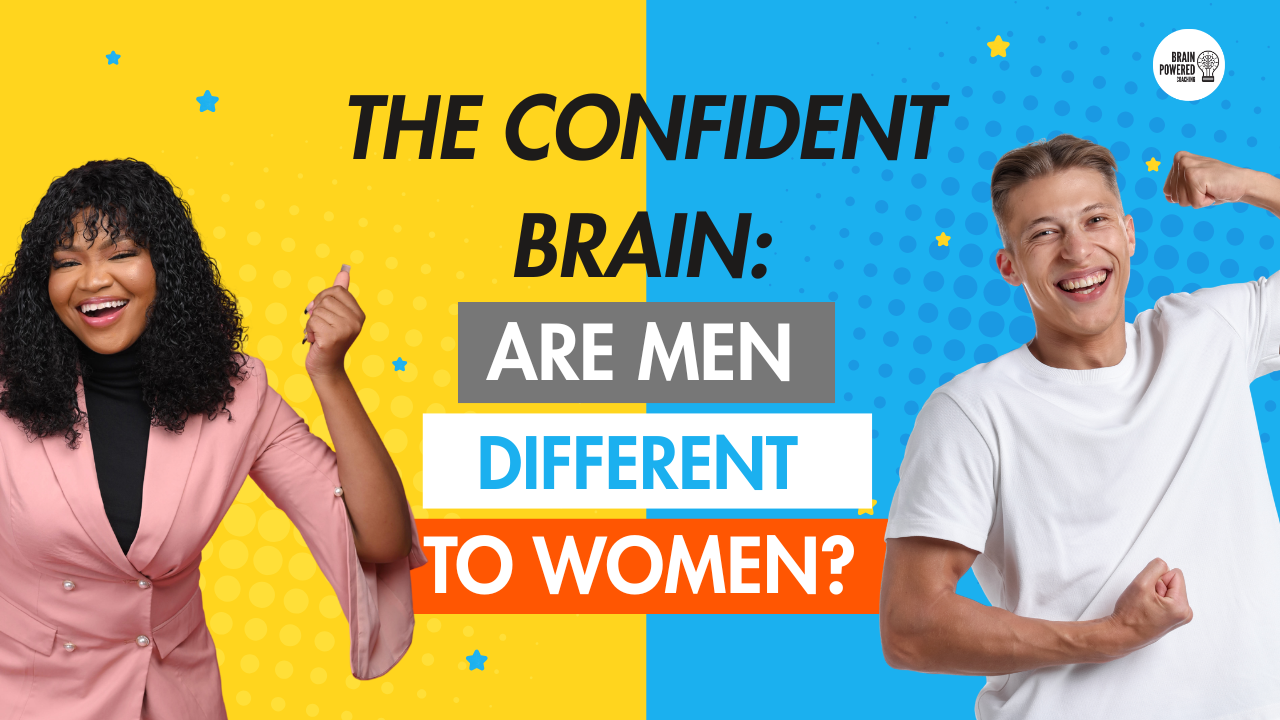
I meet highly capable women who question themselves despite clear evidence of success. I also meet men who step forward confidently, sometimes before they are fully ready. There are also many examples of men and women who oscillate between the two.
This is not about talent. It is about how confidence is built, reinforced and expressed differently.
As we mark International Women's Day, this conversation feels especially important. Because when we understand how confidence forms, we stop blaming ourselves and start leading ourselves intentionally.
Let’s unpack what might be happening here and research showing why there seems to be this pattern of behaviour👇
1️⃣ Emotional Processing Shapes Early Confidence
One key difference lies in the amygdala, the brain’s emotional processing centre.
Research suggests that during adolescence, females often show stronger activation in this region. Emotional experiences such as criticism, rejection and comparison can be processed more intensely.
In practice:
- Girls may internalise feedback more deeply
- Self-doubt can carry stronger emotional weight
- Self evaluation often becomes cautious and reflective
Boys, on average, may not embed emotional feedback as deeply. Confidence can remain steadier after setbacks. This early pattern influences how confidence may develop over time.
2️⃣ Risk Taking vs Cautious Calibration
Statistically, men are more likely to overestimate their abilities ('yep, I'll nail that job!'). Women are more likely to underestimate themselves, even at equal performance levels.
Men often:
- Take opportunities before feeling fully prepared
- Apply for roles meeting only some criteria
- Assume capability and adjust later
Women often:
- Wait until they feel fully competent
- Seek validation before stepping forward
- Carefully assess potential weaknesses
Neither approach is wrong. One leans towards action, the other towards accuracy. But in environments that reward visibility and boldness, overestimation can be interpreted as leadership.
It is worth asking: how many brilliant women are holding back simply because their internal calibration is more cautious? How can we support women to back themselves more?
3️⃣ Self Reflection Is Processed Differently
When we think, “I’m good at this” or “I can’t do that”, specific brain regions activate.
- Women: Engage more analytical and emotionally integrated processing. Self assessment often considers context, relationships, and impact.
- Men: Show more direct self-evaluation patterns, less emotionally layered.
Put simply:
- Women ask: “How did that affect others and what could I improve?”
- Men ask: “Did I succeed or not?”
Over time, these subtle differences shape very different confidence narratives.
4️⃣ Biology Sets Tendencies. Culture Amplifies Them
Biology may influence starting points. Culture magnifies them.
In many Western societies, the gender gap in reported self-esteem is more pronounced. Social conditioning, media messaging, and leadership norms shape how safe it feels to express confidence. I saw this difference when I worked in Singapore, with a team across 13 countries vs. my team in the UK and US.
International Women’s Day is not only about celebrating achievement. It is about challenging the systems and narratives that make confidence feel conditional for women.
Confidence is not hard-wired. It is reinforced.
5️⃣ Confidence Is a Neural Pattern, Not a Personality Trait
Self-esteem is a repeatable neural process.
Every time you interpret feedback, compare yourself, take a risk or hold back, your brain strengthens certain pathways:
- Repeated cautious self-evaluation → pathway strengthens
- Repeated action despite uncertainty → pathway strengthens
Neurological tendencies plus behavioural reinforcement create diverging confidence patterns. Those messages saying 'I'm not good enough' or 'I trust myself' can shift us in two different directions.
🔑 What This Means Practically
Understanding these differences is not about division. It is about awareness.
For women:
- If you lean towards cautious self-assessment, recognise it may reflect emotional processing, not lack of ability. Trust yourself; know that you will figure it out even if you don't know it all right now.
- Track achievements and balanced feedback to counter internal bias - this is my Monday morning celebrations that I write down, as well as daily journaling. Try it!
For men:
- Natural confidence is powerful. Use it and look for opportunities to support others to build theirs too.
- Anchor it in reflection and honest feedback to strengthen credibility and identify your blind spots (yes, we all have them!)
For everyone:
- Confidence is adaptable
- Neural patterns can be trained
- Confidence is not fixed
-
If you think ‘I don't agree - that’s not me', I get it - we humans are a wonderful blend of so many aspects of our life, so you may think otherwise! I’d love to hear how you experience confidence. Just hit ‘reply’
This International Women’s Day, the most powerful shift is this:
The issue is rarely capability.
It is interpretation.
When we understand how confidence forms differently, we stop personalising self-doubt and start approaching it strategically.
And that changes everything ✨
📚 References
|