|
She sat across from me, completely terrified. A senior leader, primary earner in her household, and she'd been made redundant the week before. From that moment, the clock was ticking - mortgage, kids, bills, no room to slow down.
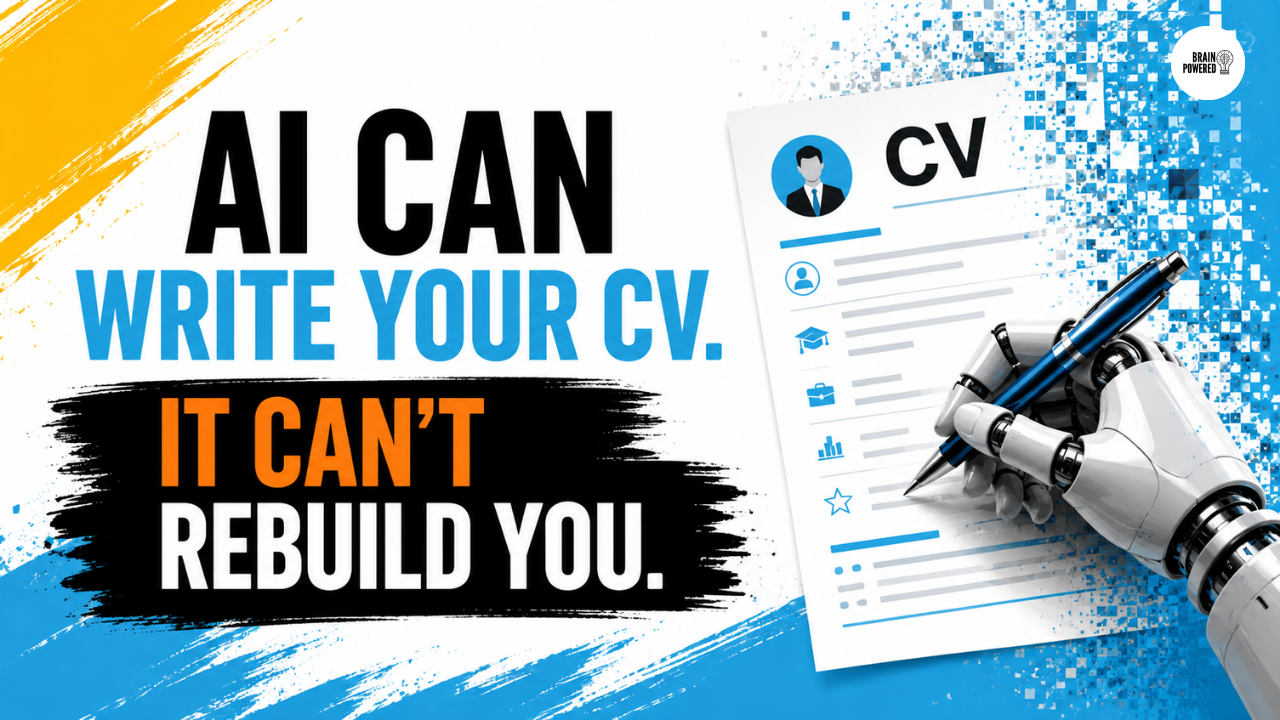
So she did what most people do now: she opened ChatGPT and asked it to write her CV, and what came back was polished, professional, and confident-sounding. She told me she felt relieved. One thing off the list, and now she could move on to the next stage of panic.
A few weeks later, she'd applied to dozens of roles and heard nothing back; that's when she came to me.
🧠 Why your brain reaches for AI the moment you're made redundant
Here's the part most people don't talk about. When you're made redundant, your brain doesn't sit you down and run a calm strategic review of your career - it goes into threat mode. Cortisol rises, and your prefrontal cortex (the part responsible for nuanced thinking, planning, and recalling specific memories) starts running on reduced power.
So when you sit down to write your CV, you genuinely cannot remember the moments that made you good at your job. You can remember your job titles and roughly what you did, but the specific story about the time you turned around a failing team, or the night you stayed late to fix the problem nobody else spotted? Those memories are sitting just out of reach, because your brain has bigger things to worry about right now - like survival.
So you reach for AI, and honestly, this is not laziness, it's biology. Your brain is doing exactly what it's supposed to do under threat - looking for shortcuts, conserving energy, getting you to the next thing. The problem is that the shortcut takes you in the wrong direction.
👀 Why recruiters' brains switch off the moment they read it
Here's what's happening on the other side of that AI-written CV. A recruiter opens your application and their brain is doing something called pattern recognition - scanning at speed, deciding within seconds whether to keep reading or move on. What their brain is wired to notice is difference - specificity, anything that breaks the pattern.
Generic language does the opposite. "Results-driven professional with strong leadership skills" doesn't light up anything in the reader's brain because their brain has seen that exact phrase a thousand times this week, so it gets filtered out before it's even consciously processed.
But something like "I rebuilt our delivery process during a staffing crisis and reduced delays by 18 % in three months" activates something completely different. The brain responds to concrete sensory detail - numbers, scenes, moments - and it pulls the reader in because it has to actually imagine what happened. That's where attention lives.
So the AI-polished CV doesn't just fail to stand out, it actively triggers the recruiter's brain to switch off. You've been told all your professional life that polish equals professionalism, but in a post-redundancy CV market, polish is what makes you invisible.
⚠️ Here's the brutal part
When you let AI write your CV after redundancy, you're not just losing interviews - you're losing the one conversation you most need to be having with yourself right now.
Because writing your own CV (actually sitting with your career and remembering what you did and why it mattered) is not an admin task, it's an identity task. It's the moment you reconnect with who you actually are, after someone has just told you that you're not needed. And when you skip that and let AI do it for you, you skip the part that rebuilds you.
That AI-written CV felt like relief because it was relief - it saved you from the painful work of remembering yourself. But that painful work is the work.
🎙️ Your voice and your confidence are the same thing
There's a part of the brain called the Default Mode Network, and it's the system responsible for your self-narrative - the story you tell yourself about who you are, what you've done, and what you're capable of. Redundancy disrupts that system. It interrupts the story, and you stop being "the person who runs operations" or "the person who built that team" and you become "the person who got let go." The narrative breaks.
When you write your own CV (in your own words, with your own specific examples) you are literally rebuilding that self-narrative. You are reminding your own brain who you are, and you are reactivating the network that holds your professional identity together and that rebuilds your confidence. When you outsource that to AI, you skip the rebuild.
That's why people who've used AI for their CV often tell me they still feel shaky going into interviews. Of course they do - the CV got written, but they didn't. Your voice on the page is not a vanity thing, it's where your confidence comes from.
🤖 So, where does AI actually help?
I'm not anti-AI, I use it, it's brilliant. Let AI handle the 80 % that doesn't carry your identity - structure, formatting, keyword suggestions, grammar, tightening sentences. All of that is genuinely useful and saves real time.
But the 20 % that does carry your identity (your voice, your specific moments, your wins, your decisions, your story) has to come from you. Not because of some moral principle, but because it's the only part that actually rebuilds you while you write it.
💡What shifted for my client
We threw the AI CV away and started again, but this time I asked her about specific moments - the crisis she'd handled, the team she'd built, the deal she'd closed when everyone said it was dead. She started telling me her real story rather than the generic version of it, and that fundamentally shifted the conversation she was having - first with herself, then on the page, then in interviews.
Her CV stopped sounding like a polished stranger and started sounding like her, and the interviews followed within weeks. But the bigger thing (the thing she told me afterwards) was that somewhere in that process, she got herself back.
That's what's actually at stake when you reach for AI after redundancy. Not interview rates. You.
You can find more about the neuroscience of career transition in our other blogs, social media (@brainpoweredcoaching) and in my book Confident. Find it here;
And if you're an HR or People leader thinking about how your organisation supports people through redundancy - this is the work we do. Most outplacement programmes are still teaching CV templates. We're rebuilding the person writing them. Learn more here and DM me if that's a conversation worth having.
📚 References
|