Confidence Has a Blind Spot: Metacognition Finds It
Oct 20, 2026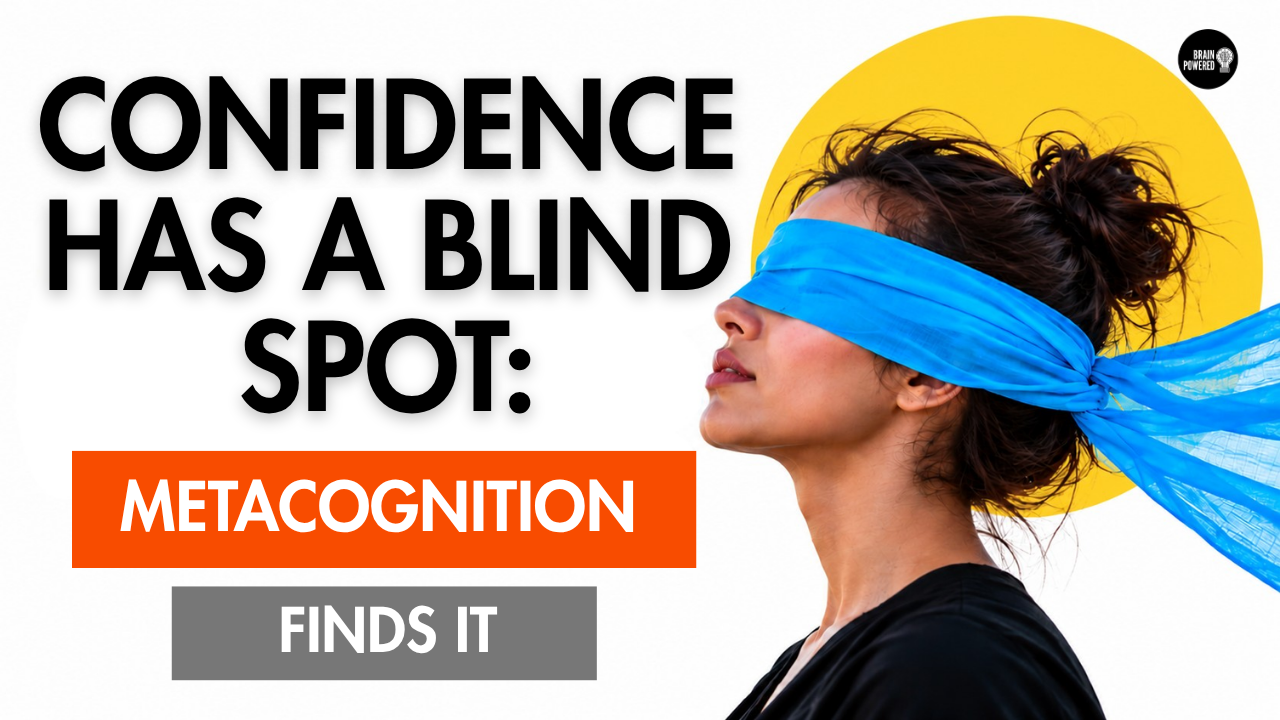
Confidence Has a Blind Spot...
You know that moment when you’re 100% sure of something? No doubt, no questions - you’ve seen it before. And then you realise you’re wrong.
My robot (Claude) does this too. I’m frequently amazed at how certain it is. Its conviction is watertight, until it isn’t. “Sorry Caroline, I misled you there, I was wrong,” it says. Holy moly - good thing I checked!
But here’s what I didn’t notice at the time. How did I know the correction was right? I didn’t. I trusted the second confident answer because it matched my gut. My checking came from intuition, experience and a sense that something didn’t feel right. That was useful, but it was just another confidence signal, and it needed checking too.
That’s metacognition: thinking about your own thinking. And it turns out to be a separate skill from being good at what you do.
Some of my most confident calls have been dead right. Some have been completely wrong. I felt exactly the same certainty going into both. Confidence isn’t a useless signal - it’s an uncalibrated one. The question isn’t whether to trust it. It’s whether this particular feeling, in this particular moment, has earned that trust.
⚖️ Two different abilities
Being right and knowing how likely you are to be right are two different abilities.
- The first is performance: did you get the answer correct?
- The second is what researchers call metacognitive sensitivity: your ability to judge accurately how trustworthy your own judgement is in a specific moment.
The two can come apart. Plenty of highly capable people are poor at knowing when their certainty is shaky. Plenty of less naturally skilled people are excellent at knowing exactly when to double check themselves.
🧠 What the brain scans suggest
In a study published in Science, Fleming and colleagues asked people to make a simple perceptual judgement and then rate how confident they were. They adjusted the difficulty so that everyone performed at roughly the same level. Even so, people differed widely in how well their confidence tracked their accuracy. Those differences were linked to the structure of a region at the front of the brain, the anterior prefrontal cortex.
It was a small, correlational study, so it doesn’t tell us where metacognition “lives”. But together with later work, it strongly suggests that knowing when to trust yourself is an ability in its own right. Two people can perform identically and still differ greatly in their ability to know which decisions to trust.
📊 What our data says
In Brain Powered’s 2024 confidence research with more than 17,000 people, 91% told us they question themselves and second-guess their decisions, and 90% said they worry about making mistakes.
The easy reading is that this is a confidence problem. I’m not so sure. Second-guessing isn’t the issue - checking is exactly what good decision makers do. The question our data can’t answer, and the one worth asking yourself, is whether your doubt is landing on the right decisions.
Doubting everything is exhausting and slow. Doubting nothing is how confident mistakes happen. Being well calibrated sits in between: saving your doubt for the decisions where you’re most likely to be wrong.
💼 Why this matters at work
Most organisations reward people who sound certain. Confident voices get heard in meetings, get promoted and get trusted with the big calls. The research backs this up: across a series of studies, overconfident people gained higher status in groups, whether or not their ability justified their confidence (Anderson et al., 2012). But a flat, generic level of self-belief isn’t what makes good decisions. What separates strong decision makers is confidence that rises and falls with the actual stakes and uncertainty.
The colleagues I trust most under pressure aren’t the ones who feel sure about everything. They’re the ones who can say “I’m 90% on this one and 50% on that one” - and be right about the difference.
And as AI gives us fluent, confident answers on demand, this matters more, not less. The machine’s certainty tells you nothing about whether it’s right. Neither, on its own, does yours.
🌱 The good news: it can be trained
In a 2019 study, participants practised rating their confidence and received feedback on how well those ratings matched their actual accuracy. Their metacognition improved, and the gains carried over from a perception task to a memory task. These were lab tasks, so we don’t yet know how far the effect reaches into the boardroom. But the mechanism is simple enough to borrow: predict how sure you are, check what actually happened, and adjust.
🔍 Three questions I now ask
On calls that matter - my own, and increasingly when I’m listening to a client think through theirs - I split one question into three:
- How confident do I feel about this - and, separately, how much should I trust that feeling right now?
- When have I felt this certain before and been wrong?
- Is this situation genuinely familiar, or does it just feel familiar?
Most of the time, I had been trusting the feeling without asking whether it had earned that trust. That’s the real blind spot. Not the wrong call, but failing to check which calls deserve your trust in the first place.
✍️ Try this: for the next week, before three decisions that matter, write down how confident you are as a percentage. A week later, check what actually happened. Then tell me in the comments: where was your confidence well placed, and where did it let you down?
📚 References
- Anderson, C., Brion, S., Moore, D. A., & Kennedy, J. A. (2012). A Status-Enhancement Account of Overconfidence. Journal of Personality and Social Psychology, 103(4), 718-735. https://doi.org/10.1037/a0029395
- Brain Powered Coaching (2024). Confidence research, 17,000+ respondents. Reported in Brewin, C. (2025). Confident. Grosvenor House Publishing.
- Carpenter, J., Sherman, M. T., Kievit, R. A., Seth, A. K., Lau, H., & Fleming, S. M. (2019). Domain-General Enhancements of Metacognitive Ability Through Adaptive Training. Journal of Experimental Psychology: General, 148(1), 51-64. https://doi.org/10.1037/xge0000505
- Fleming, S. M., & Dolan, R. J. (2012). The Neural Basis of Metacognitive Ability. Philosophical Transactions of the Royal Society B, 367(1594), 1338-1349. https://doi.org/10.1098/rstb.2011.0417
- Fleming, S. M., Weil, R. S., Nagy, Z., Dolan, R. J., & Rees, G. (2010). Relating Introspective Accuracy to Individual Differences in Brain Structure. Science, 329(5998), 1541-1543. https://doi.org/10.1126/science.1191883
- Fleming, S. M. (2021). Know Thyself: The Science of Self-Awareness. Basic Books. https://www.hachettebookgroup.com/titles/stephen-m-fleming/know-thyself/9781541672840/
SUBSCRIBE FOR WEEKLY LIFE LESSONS
We hate SPAM. We will never sell your information, for any reason.
Author

