Job Loss Fog: what’s really going on in your brain? 💭
Aug 26, 2026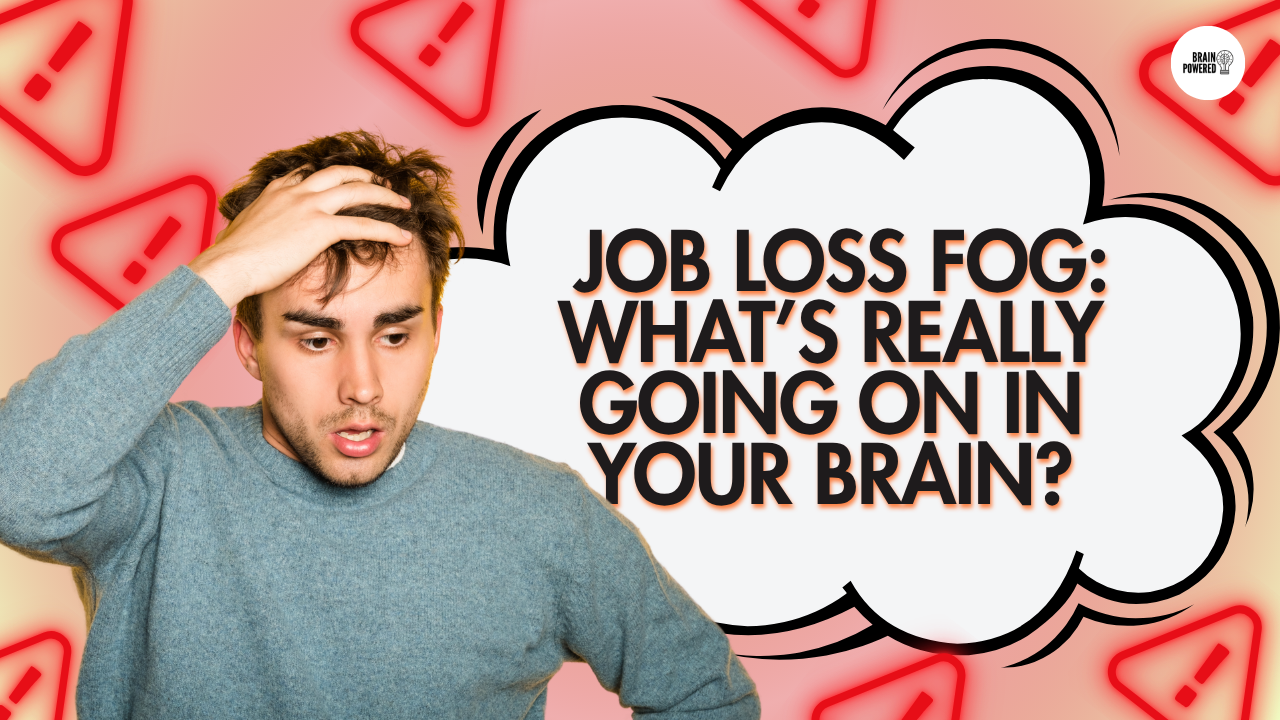
I’ve sat on both sides of the redundancy conversation. The side where you’re delivering the news, watching someone’s face change. And the side where you’re sitting opposite someone six weeks later, and they tell you they can’t think straight, can’t make decisions, can’t seem to get traction on anything - and they’re starting to wonder if something’s wrong with them. Nothing is wrong with them. Or with you, if this is where you are right now. There’s just something the career advice industry rarely tells you: The moment you most need to make clear, confident decisions about your future is the exact moment your brain is least equipped to make them. Not because you lack resilience. Not because you aren’t tough enough. Because of a hormone called cortisol - and what sustained levels of it actually do to the organ you’re relying on to get yourself back on track.
🌫️ Why it feels like “fog”
That sense of mental fog, confusion, and overthinking after losing your job is not random. It’s your brain under stress chemistry, temporarily shifting away from clarity and into protection mode. This is what we’re really talking about when we say Job Loss Fog.
🧬The biology nobody mentions
Cortisol is your primary stress hormone. In short bursts, it’s genuinely useful - it sharpens focus, prepares your body for action, helps you respond fast. But the kind of stress that follows redundancy isn’t a short burst. It’s ongoing uncertainty. And sustained cortisol does something that should change how you think about the weeks ahead entirely.
🧠It impairs your prefrontal cortex
Neuroscientist Amy Arnsten at Yale has spent years documenting how even relatively mild, uncontrollable stress causes rapid loss of prefrontal cognitive function. This is the part of your brain responsible for: • rational thinking • weighing consequences • long-term planning Everything you’re currently trying to use to figure out what comes next. Your brain hasn’t abandoned you. It’s reassigned its resources to survival. Which feels urgent. Which is the problem.
⚠️ Why the pressure to move fast is working against you
Update your CV. Get on LinkedIn. Start applying. Keep busy. The standard redundancy advice is built on the assumption that action equals recovery. But here’s what elevated cortisol actually does to decision-making: it pushes you towards short-term, risk-averse choices. You become more likely to:
- take the first thing that feels safe rather than right
- undersell yourself
- undervalue your experience
- accept less than you’re worth
Not because you don’t know better. Because your brain is running on a threat response, not a growth mindset. The urgency you feel to fix everything immediately is a cortisol symptom. It is not a reliable signal about what you should actually do next.
🌿 The question that changes everything
Before any significant decision - a job application, a salary negotiation, a pivot - ask yourself: Am I deciding from clarity, or from cortisol? If you’ve slept badly, skipped meals, or haven’t moved your body in days, you already know the answer. Give it twenty-four hours.
⚒️ What actually helps
The goal in the early weeks isn’t to have all the answers. It’s to restore your brain’s capacity to find them. A few things that are evidence-based, rather than vague:
🚶♀️Move your body Movement is one of the most direct ways to metabolise cortisol. Not because exercise is good for you in a general wellness sense, but because it chemically processes what stress hormones are doing in your body. Twenty minutes is enough to shift your neurological state.
 Box breathing Four counts in, four hold, four out, four hold. It activates the parasympathetic nervous system and shifts you out of acute stress response within minutes. Surgeons and special forces use it for a reason.
📅 Create certainty wherever you can Uncertainty is a primary cortisol driver. A daily structure. A weekly rhythm. Knowing what you’re doing tomorrow morning. These aren’t coping mechanisms - they’re neurological signals that your environment is safe enough to think in.
🤍Moving out of the fog
The Job Loss Fog lifts when your nervous system is no longer running in constant survival mode. That clarity you’re trying to force right now doesn’t come from pushing harder. It comes from allowing your brain to return to thinking mode instead of threat mode. That version of you is still there. She just needs the right conditions.
A question for you: What’s one decision you’ve been pushing yourself to make this week that could wait twenty-four hours? Hit reply and tell me. Sometimes naming it is the first step out of the fog.
References 📚
Sapolsky, R. M. (2004). Why Zebras Don’t Get Ulcers. Holt Paperbacks
SUBSCRIBE FOR WEEKLY LIFE LESSONS
We hate SPAM. We will never sell your information, for any reason.
Author

