Are You Adapting to AI or Falling Behind It? 🤖
Aug 26, 2026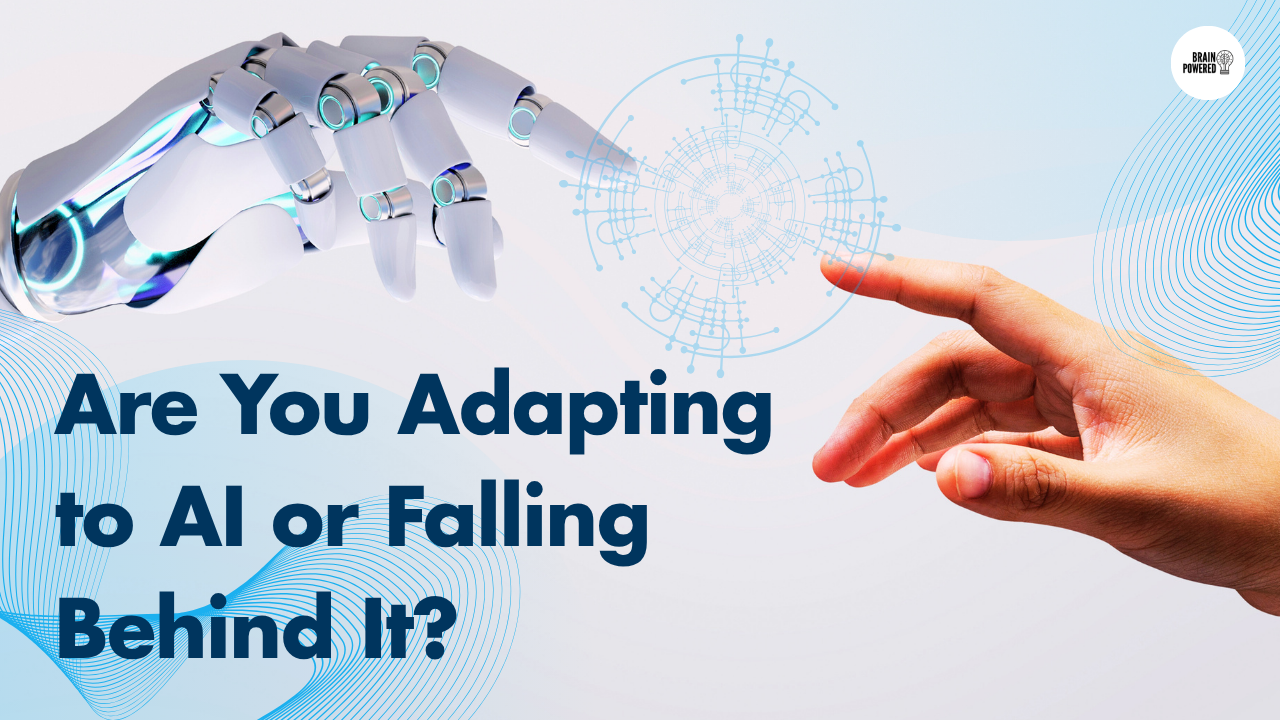
I’ll be honest with you.
There was a moment when I caught myself hesitating.
Not because I didn’t understand AI. Not because I couldn’t see its potential. But because, like many people, a quiet thought kept creeping in:
“What if this replaces what I do?”
If you’ve felt that, you are not alone. But here is the shift that changed everything for me.
AI is not something to fear. It is something to learn how to use as our PARTNER. 🤖
The Fear Is Understandable, But Perhaps Misplaced
Let’s be real.
Yes, AI will change how we work.
Yes, it will automate parts of some jobs, all of others.
And yes, some roles will evolve faster than expected.
That is reality.
But the idea that AI will simply replace everyone is where people get stuck. Because when fear takes over, the brain does something very human.
It freezes. 🧠
What Is Happening in Your Brain
When something feels uncertain and high stakes, your brain’s threat system activates. The amygdala flags it as danger. Our body prepares to protect us and when it feels too big or too unclear?
We do not act.
We pause.
This response is well studied in behavioural science and neuroscience. I'm seeing it with my clients - they are struggling to make decisions, commit and move forward.
So if you have been avoiding AI or putting it off, it is not a lack of ability. It is your nervous system doing its job.
But Here Is the Reality We Need to Face
AI is a tool 🔧 that we need to use as a partner, not to offload our thoughts and judgement. It does not replace people who know how to use it well, instead, it amplifies them (you can see an interview I did on Ticker TV talking about the dangers here)
The real risk is not AI taking your work overnight.
It is staying still while others quietly become faster, sharper, and more efficient with it.
This Is Not About Working Harder Anymore
It is about working smarter. 💡 The people making the biggest progress are not necessarily more skilled.
They are simply asking better questions:
- How can this save me time?
- How can this improve what I already do?
- How can this support my thinking instead of replacing it?
AI can draft, summarise, analyse, and organise, but it still needs YOU: Your judgement. Your direction. Your experience. That part is not going anywhere.
The Shift I Had to Make
I stopped seeing AI as something that might replace me and started seeing it as something that could support me - not perfectly, not instantly, but practically.
Small steps:
- Using it to speed up drafts ✍️
- Refining ideas instead of starting from scratch
- Freeing up time for deeper thinking
And something interesting happened - the fear did not disappear completely, but it stopped leading my decision making. As I told an AI expert I was dealing with: I'm "thawing selectively" from my AI freeze.
The Real Divide Is Not AI vs Humans
It is this:
- People who avoid the tool
- People who learn how to use it
Because AI will not replace human capability, but people who use AI well will absolutely move faster than those who do not.
If You Are Feeling That Freeze
Start small. One task. One tool. One try. That is enough.
Because in neuroscience terms, action reduces fear over time. Each step gives your brain new evidence that this is manageable.
Final Thought
So, if you have been hesitating, ask yourself:
What could this tool make easier for me today? I'd love to hear how you're using it - just hit reply.
Until next time,
Caroline
References 📚
SUBSCRIBE FOR WEEKLY LIFE LESSONS
We hate SPAM. We will never sell your information, for any reason.
Author

